Saturday, 4 May 2013

'Clydebourne Park' by Bruce Norris

Poster from Putney Arts Centre
I saw this production at The Putney Arts Centre, directed by Ian Higham.
This was a very enjoyable performance of both a witty and meaningful play. I had never seen or heard of this play before and immediately appreciated it. Later did I find out it was the most successful new play of 2011and is the only play to ever win the Pulitzer Prize for drama as well as the Olivier, Evening Standard and Tony awards.
The twist of how a Chicago neighborhood turns from elitely white to black is clever and I like the way the characters in the first act all play the characters in the second act.
Set for Act One
Photography by: Marina Bussandri
In this production Michael Rossi gave a strong performance as Russ, the All-American husband in Act One. Richard Brent was incredible in both his roles of Karl in Act one and Steve in Act two.
Scene from Act One
Photography by: Marina Bussandri
Some of the other acting was not so credible but the play was great nevertheless. I was impressed with the staging. In Act one it was the living room of a house in the neighborhood, which held histories. There was the front door of the house which led into it and a staircase that led up from it. Both were believable and used well. The lighting outside the 'front door' of the house was incredibly realistic of daytime and added to the idea of the house being part of the neighborhood, instead of singling the set out as a random house with no surroundings.
The Reverand character in Act One wore a wig (he was bald and used that look in Act Two). I understand needing to make a distinction between the two characters however the wig used was almost like an Elvis wig which was very distracting and in conjunction with the actor's terribly false American accent, almost took the play into a level of slapstick rather than actual humor.
However on the whole I really enjoyed this show, and was amazed at some of the performances given.
Scene from Act Two
Photography by: Marina Bussandri
DirectorIan I
Ian Higham
Director
Ian Higham

Cast
Russ/Dan - Michael Rossi
Bev/Kathy - Amanda Benzecry
Karl/Steve - Richard Brent
Betsy/Lindsey - Elly Lacey
Francine/Lena - Ade Gbinigie
Albert/Kevin - Brian Yansen
Jim/Tom - Charles Golding
Ian Higham

Cast
Russ/Dan - Michael Rossi
Bev/Kathy - Amanda Benzecry
Karl/Steve - Richard Brent
Betsy/Lindsey - Elly Lacey
Francine/Lena - Ade Gbinigie
Albert/Kevin - Brian Yansen
Jim/Tom - Charles Golding

Quotations About Illusion

"Illusion is the first of all pleasures." - Oscar Wilde

"If we choose, we can live in a world of comforting illusion." - Noam Chomsky

"What if everything is an illusion and nothing really exists? In that case, I definitely overpaid for my carpet." - Woody Allen

"Everything's fine today. That is our illusion." - Voltaire

"Infinite love is the only truth. Everything else is illusion." - David Icke

"Making films is sort of like pulling off a magic trick. It's sort of like an illusion. It's not real but you want it to appear real, and all kinds of things go into that, from the clothes you're wearing to the make-up, to the light." - Jeff Bridges

"The secret to film is that it's illusion." - George Lucas

"We live in a fantasy world, a world of illusion. The great task in life is to find reality." - Iris Murdoch

"The thing about performance even if it's only an illusion, is that it is a celebration of the fact that we do contain within ourselves infinite possibilities." - Sydney Smith

"One travels to escape from it all, but that is the illusion: It cannot be done, since one travels with one's mind." - Ella Maillart

"Illusion is an anodyne, bred by the gap between wish and reality." - Herman Wouk

""I no longer worry whether a painting is about something or not. I am only concerned with the expectation, from a flat surface, of an illusion." - William Scott

"We're living under the illusion that we have the power to determine what to do with it." - Mordecai Wyatt Johnson

"Reality is merely an illusion, albeit a very persistent one." - Albert Einstein

"It is far more difficult to murder a phantom that a reality." - Virginia Wolf

"Magic is the only honest profession. A magician promises to deceive you and he does." - Karl Germain

"Why do we call all our generous ideas illusions, and the mean ones thruths." Edith Warton, The House of Mirth

"To understand yourself: Is that a discovery or a creation?" - Pascal Mercier, Night train to Lisbon

"If you are not careful you will end up living the illusions that others have created for you." - Steven Redhead, The solution.

Notes on Deception

+ Deception, deceit, bluff and beguilement are acts to propagate beliefs that are not true or not the whole truth (half-truths, omissions).
+ Camouflage & concealment
+ Five primary types of deception are:
   1) Lies - Making up information or giving information that's opposite or very different from the truth.
   2) Equivocations - Making an indirect, ambiguous or contradictory statement.
   3) Concealments - Omitting information or engaging in behavior that helps hide relevant information.
   4) Exaggerations - Overstatement or stretching the truth to a degree.
   5) Understatements - Minimization or downplaying aspects of the truth.
+ Motives can include, parter focused, self focused or relationship focused.
+ Camouflage is a form of visual deception (e.g. Military)
+ A disguise is an appearance to create the impression of being somebody or something else.
+ Simulation consists of exhibiting false information.
+ The three simulation techniques are:
   1) Mimicry, copying another model.
   2) Fabrication, making up a new model.
   3) Distraction, offering an alternative model.
+ Rationale for such deceptions is that humans are sensitive to how they appear to others, this self- consciousness will affect how they behave and appear.

Wednesday, 1 May 2013

Improving Drawing Skills (Character Drawing)

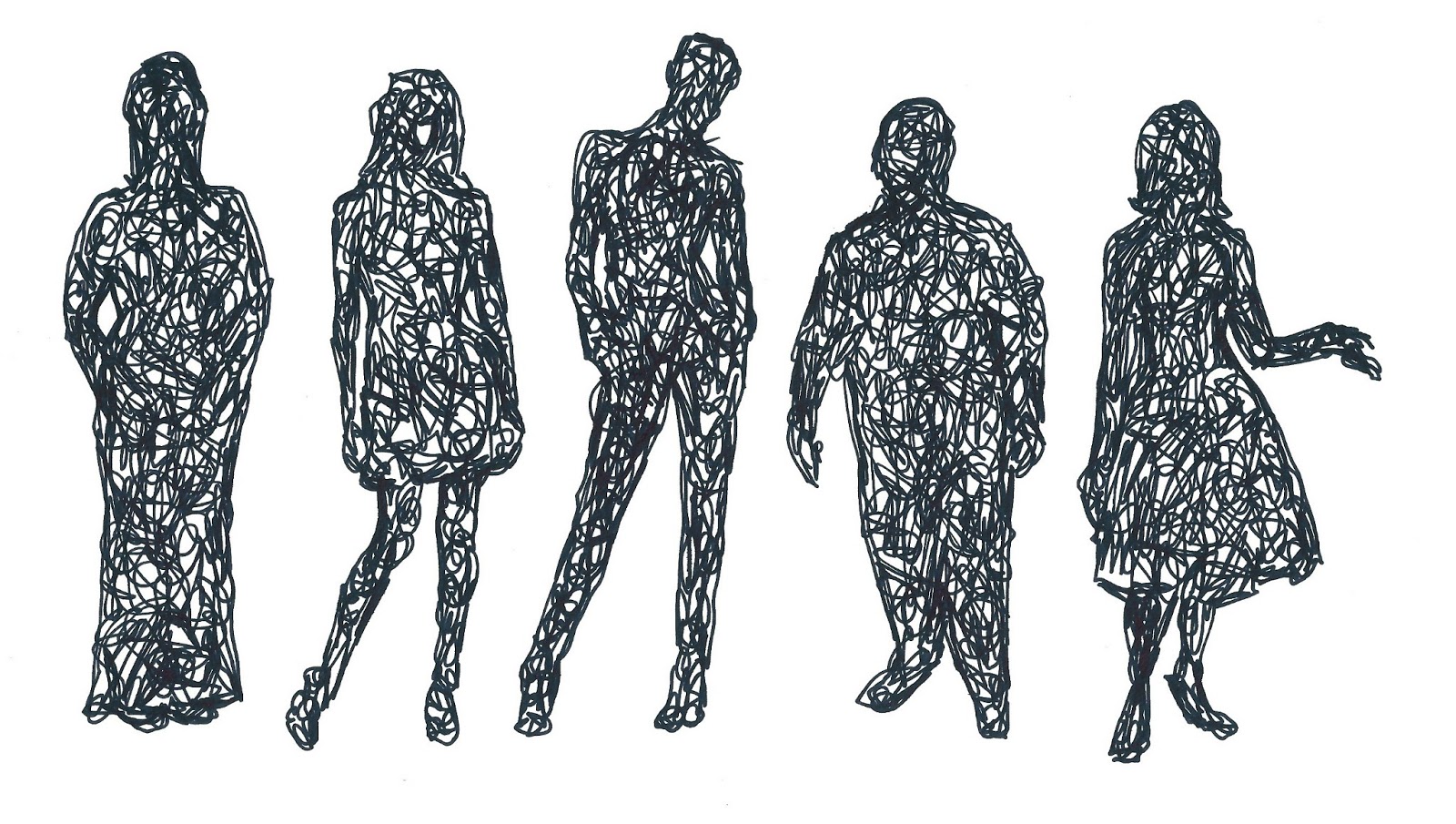
These are all sketches in which I tried to improve my character drawing skills. I looked at how the body moves, proportion, faces and using different line techniques.


Monday, 29 April 2013

Which Characters?

I have realised that to design in depth for the costumes in "The Importance of Being Earnest" it is better to choose some characters, or some scenes, for this very short project. The time limitation means that to use my time efficiently I believe it would be better to focus on a couple of characters in depth, their change from scene to scene, and really outline their identity within my costume designs.
Male and female character is definitely the direction I would like to go in, otherwise the effectiveness of my all female cast would be lost in translation and the production is not actually being performed. It will also help me illustrate the current androgyny in womenswear.
Personally the characters of Algernon and Cecily, are my favourite couple in the play and there is the opportunity to design with contrast. Algernon the elaborate and mischievous bachelor and Cecily the young innocent country girl. In terms of colour and shape, designing for these two characters would be most enjoyable I think, and allow me to create something the most visually interesting for the audience to enjoy. Lady Bracknell is another character that I would enjoy to design for, however I think the time limitation is too short and therefore would affect in a bad way the quality of my designs for Algernon and Cecily. Consequently, I will only do this couple (A & C ) in depth. However, I could possibly create an entire cast sketch in the set, perhaps the last scene, which would allow me to create a fuller context in which my costume designs would be seen and the chance to design simplistically the other characters.

Personal Tutorial

After speaking to my tutor today, I have some issues to resolve in my project:

1)  We discussed my overall design approach to the brief and I received positive feedback. My all female cast idea was taken well giving me a little more confidence in the idea and consequently I am choosing to stick with this.

2) The idea for the fabric (fragmented Victorian wallpaper pattern, inspired by analytical cubism), we decided was one layer too many. I've decided to just use the original wallpaper patterns as there is a nice alliance between female cast and this fabric. It emphasises the rigid society in Victorian times, what was expected fo women and where they would spend all their time, in these rooms covered in this wallpaper.

3)My design sketches are too fashion based and therefore I need to research into costume illustrators and make drawings which are more expressive and tellng of the characters. *NB, Pamela Howard.

4) Emphasis on need for a set design to give the costumes a fuller context (world they would be seen in).

5) The costume sketches should not be on a plain white background, use a pattern, collage, somethign to give greater context and information about the costume.

Thursday, 25 April 2013

Notes on Psychology of Dress


Chapter Six: Appearance Management and Self Presentation
  • In everyday life we are caught up in the act of appearing before others.
  • We present existing and idealized images of self.
  • By managing appearance we can try to shape others’ understandings of our identities.
  • Clothes act as props, helping us move form one role to the next (theatre metaphor).
  • Appearance management involves experimentation and self-expression.
  • Displaying self to others in a social context, i.e. Self presentation.
  • Our lives are interwoven with those of others around us.
  • Our self-concepts provide some guidelines for dressing (“that’s me” versus “that’s not me”).]
  • We are likely to dress differently when we are alone and when we are with others, The private context of self is likely to involve inner dialogue and thought process, experimentation and fantasy.
  • Joanne Eicher (1981) uses the term secret self to refer to the self that may not be shared with any other person and notes that the secret self can dress to fulfil fantasies.
  • Fantasy clothes may be sexual or bold colours that would not be worn in public. For example conflicts of gender and age may be apparent in the secret appearances of some troubled adolescents as noted by Michelman and Michelman (1986).
  • The public context of self is especially likely to include concern about others’ perception of us.
  • What motivates us to think about our self presentations? In part, desire to seek and maintain a sense of personal control/power to exert influence over present and future events. May wish to engage in self-presentation for purposes of individually or socially induced concerns.
  • Public expression of self becomes an arena for constructing a compromise of actual and ideal self image (Baumeister, 1986).
  • Self promotion, appearance display for perusal of others, to further the self in some way- as is common in a job interview or politics.
  • A concept that enables us to understand perceptions of self across contexts is identity. An identity is the organised set of characteristics an individual perceives as representing or defining the self in given social situations.
  • Although people have on self-concept, they may have contextually relevant identities (Troiden, 1984). For example, a person is likely to dress and behave differently in class than at a party, or when interacting with their mothers than with a date.
  • Through the process of self-identification, individuals places (locate or identify) and express their own identities.
  • Appearance management allows them to anticipate what identities they would like to have in a social situation, so they can present themselves accordingly to others.
  • “All the world’s a stage
And all the men and women merely players:
They have their exits and their entrances;
And one man in his time plays many parts” – ‘As You Like It’, Act 2, scene, Shakespeare.
  • Is all the world a stage, with all people as performers of roles? In looking at self concept and appearance, we have seen that clothes most likely represent more in our daily personal and social lives than costumes for performances before others. Yet appearance management as a form of behaviour may be characterized in part by performance of the self in context.
  • The social- psychological perspective in sociology known as dramaturgy draws analogies between human behaviour and the theatre.